Wednesday, April 25, 2012
Graphene Boosts Efficiency of Next-Gen Solar Cells
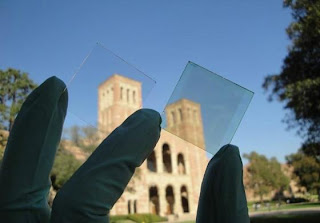
The coolest new nanomaterial of the 21st century could boost the efficiency of the next generation of solar panels, a team of Michigan Technological University materials scientists has discovered.
Graphene, a two-dimensional honeycomb of carbon atoms, is a rising star in the materials community for its radical properties. One of those properties is electrical conductivity, which could make it a key ingredient in the next generation of photovoltaic cells, says Yun Hang Hu, a professor of materials science and engineering.
Dye-sensitized solar cells don't rely on rare or expensive materials, so they could be more cost-effective than cells based on silicon and thin-film technologies. But they are not as good at converting light into electricity.
In dye-sensitized solar cells, photons knock electrons from the dye into a thin layer of titanium dioxide, which relays them to the anode. Hu's group found that adding graphene to the titanium dioxide increased its conductivity, bringing 52.4 percent more current into the circuit.
"The excellent electrical conductivity of graphene sheets allows them to act as bridges, accelerating electron transfer from the titanium dioxide to the photoelectrode," Hu said.
The team also developed a comparably foolproof method for creating sheets of titanium dioxide embedded with graphene. It first made graphite oxide powder, then mixed it with titanium dioxide to form a paste, spread it on a substrate (such as glass) and then baked it a high temperatures.
"It's low-cost and very easy to prepare," said Hu. But not just any recipe will do. "If you use too much graphene, it will absorb the light in the solar cell and reduce its efficiency," he said.
Hu presented a talk on their work, "Graphene for Solar Cells," at the US-Egypt Joint Workshop on Solar Energy Systems, held March 12-14 in Cairo. It was funded by the American Chemical Society Petroleum Research Fund and the National Science Foundation.
[Source]
Sunday, April 22, 2012
Solar Cell That Also Shines: Luminescent 'LED-Type' Design Breaks Efficiency Record
To produce the maximum amount of energy, solar cells are designed to absorb as much light from the Sun as possible. Now researchers from the University of California, Berkeley, have suggested -- and demonstrated -- a counterintuitive concept: solar cells should be designed to be more like LEDs, able to emit light as well as absorb it.
The Berkeley team will present its findings at the Conference on Lasers and Electro Optics (CLEO: 2012), to be held May 6-11 in San Jose, Calif.
"What we demonstrated is that the better a solar cell is at emitting photons, the higher its voltage and the greater the efficiency it can produce," says Eli Yablonovitch, principal researcher and UC Berkeley professor of electrical engineering.
Since 1961, scientists have known that, under ideal conditions, there is a limit to the amount of electrical energy that can be harvested from sunlight hitting a typical solar cell. This absolute limit is, theoretically, about 33.5 percent. That means that at most 33.5 percent of the energy from incoming photons will be absorbed and converted into useful electrical energy.
Yet for five decades, researchers were unable to come close to achieving this efficiency: as of 2010, the highest anyone had come was just more than 26 percent. (This is for flat-plate, "single junction" solar cells, which absorb light waves above a specific frequency. "Multi-junction" cells, which have multiple layers and absorb multiple frequencies, are able to achieve higher efficiencies.)
More recently, Yablonovitch and his colleagues were trying to understand why there has been such a large gap between the theoretical limit and the limit that researchers have been able to achieve. As they worked, a "coherent picture emerged," says Owen Miller, a graduate student at UC Berkeley and a member of Yablonovitch's group. They came across a relatively simple, if perhaps counterintuitive, solution based on a mathematical connection between absorption and emission of light.
"Fundamentally, it's because there's a thermodynamic link between absorption and emission," Miller says. Designing solar cells to emit light -- so that photons do not become "lost" within a cell -- has the natural effect of increasing the voltage produced by the solar cell. "If you have a solar cell that is a good emitter of light, it also makes it produce a higher voltage," which in turn increases the amount of electrical energy that can be harvested from the cell for each unit of sunlight, Miller says.
The theory that luminescent emission and voltage go hand in hand is not new. But the idea had never been considered for the design of solar cells before now, Miller continues.
This past year, a Bay area-based company called Alta Devices, co-founded by Yablonovitch, used the new concept to create a prototype solar cell made of gallium arsenide (GaAs), a material often used to make solar cells in satellites. The prototype broke the record, jumping from 26 percent to 28.3 percent efficiency. The company achieved this milestone, in part, by designing the cell to allow light to escape as easily as possible from the cell -- using techniques that include, for example, increasing the reflectivity of the rear mirror, which sends incoming photons back out through the front of the device.
Solar cells produce electricity when photons from the Sun hit the semiconductor material within a cell. The energy from the photons knocks electrons loose from this material, allowing the electrons to flow freely. But the process of knocking electrons free can also generate new photons, in a process called luminescence. The idea behind the novel solar cell design is that these new photons -- which do not come directly from the Sun -- should be allowed to escape from the cell as easily as possible.
"The first reaction is usually, why does it help [to let these photons escape]?" Miller says. "Don't you want to keep [the photons] in, where maybe they could create more electrons?" However, mathematically, allowing the new photons to escape increases the voltage that the cell is able to produce.
The work is "a good, useful way" of determining how scientists can improve the performance of solar cells, as well as of finding creative new ways to test and study solar cells, says Leo Schowalter of Crystal IS, Inc. and visiting professor at Rensselaer Polytechnic Institute, who is chairman of the CLEO committee on LEDs, photovoltaics, and energy-efficient photonics.
Yablonovitch says he hopes researchers will be able to use this technique to achieve efficiencies close to 30 percent in the coming years. And since the work applies to all types of solar cells, the findings have implications throughout the field.
[Source]
Thursday, April 19, 2012
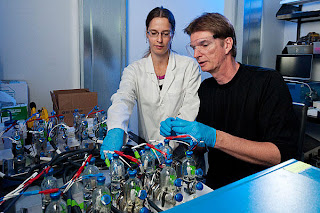
Nature's Billion-Year-Old Battery Key to Storing Energy
New research at Concordia University is bringing us one step closer to clean energy. It is possible to extend the length of time a battery-like enzyme can store energy from seconds to hours, a study published in the Journal of The American Chemical Society shows.
Concordia Associate Professor László Kálmán -- along with his colleagues in the Department of Physics, graduate students Sasmit Deshmukh and Kai Tang -- has been working with an enzyme found in bacteria that is crucial for capturing solar energy. Light induces a charge separation in the enzyme, causing one end to become negatively charged and the other positively charged, much like in a battery.
In nature, the energy created is used immediately, but Kálmán says that to store that electrical potential, he and his colleagues had to find a way to keep the enzyme in a charge-separated state for a longer period of time.
"We had to create a situation where the charges don't want to or are not allowed to go back, and that's what we did in this study," says Kálmán.
Kálmán and his colleagues showed that by adding different molecules, they were able to alter the shape of the enzyme and, thus, extend the lifespan of its electrical potential.
In its natural configuration, the enzyme is perfectly embedded in the cell's outer layer, known as the lipid membrane. The enzyme's structure allows it to quickly recombine the charges and recover from a charge-separated state.
However, when different lipid molecules make up the membrane, as in Kálmán's experiments, there is a mismatch between the shape of the membrane and the enzyme embedded within it. Both the enzyme and the membrane end up changing their shapes to find a good fit. The changes make it more difficult for the enzyme to recombine the charges, thereby allowing the electrical potential to last much longer.
"What we're doing is similar to placing a racecar in on snow-covered streets," says Kálmán. The surrounding conditions prevent the racecar from performing as it would on a racetrack, just like the different lipids prevent the enzyme from recombining the charges as efficiently as it does under normal circumstances.
Photosynthesis, which has existed for billions of years, is one of the earliest energy-converting systems. "All of our food, our energy sources (gasoline, coal) -- everything is a product of some ancient photosynthetic activity," says Kálmán.
But he adds that the main reason researchers are turning to these ancient natural systems is because they are carbon neutral and use resources that are in abundance: sun, carbon dioxide and water. Researchers are using nature's battery to inspire more sustainable, human-made energy converting systems.
For a peek into the future of these technologies, Kálmán points to medical applications and biocompatible batteries. Imagine batteries made of enzymes and other biological molecules. These could be used to, for example, monitor a patient from the inside post-surgery. Unlike traditional batteries that contain toxic metals, biocompatible batteries could be left inside the body without causing harm.
"We're far from that right now but these devices are currently being explored and developed," says Kálmán. "We have to take things step by step but, hopefully, we'll get there one day in the not-too-distant future."
[Source]
Friday, April 13, 2012
Artificial Photosynthesis Breakthrough: Fast Molecular Catalyzer
Researchers from the Department of Chemistry at the Royal Institute of Technology (KTH) in Stockholm, Sweden, have managed to construct a molecular catalyzer that can oxidize water to oxygen very rapidly. In fact, these KTH scientists are the first to reach speeds approximating those is nature's own photosynthesis. The research findings play a critical role for the future use of solar energy and other renewable energy sources.
Researchers all over the world, including the US, Japan, and the EU, have been working for more than 30 years on refining an artificial form of photosynthesis. The results have varied, but researchers had not yet succeeded in creating a sufficiently rapid solar-driven catalyzer for oxidizing water.
"Speed has been the main problem, the bottleneck, when it comes to creating perfect artificial photosynthesis," says Licheng Sun, professor of organic chemistry at KTH.
But now, together with research colleagues, he has imitated natural photosynthesis and created a record-fast molecular catalyzer. The speed with which natural photosynthesis occurs is about 100 to 400 turnovers per seconds. The KTH have now reached over 300 turnovers per seconds with their artificial photosynthesis.
"This is clearly a world record, and a breakthrough regarding a molecular catalyzer in artificial photosynthesis," says Licheng Sun.
The fact that the KTH researchers are now close to nature's own photosynthesis regarding speed opens up many new possibilities, especially for renewable energy sources.
"This speed makes it possible in the future to create large-scale facilities for producing hydrogen in the Sahara, where there's an abundance of sunshine. Or to attain much more efficient solar energy conversion to electricity, combining this with traditional solar cells, than is possible today," says Licheng Sun.
He points to the problem of skyrocketing gasoline prices, and these advances with the rapid molecular catalyzers can in turn lay the groundwork for many important changes. They make it possible to use sunlight to convert carbon dioxide into various fuels, such as methanol. And, technology can be created to convert solar energy directly into hydrogen. Licheng Sun adds that he and his research colleagues are working hard and pursing intensive research to make this technology reasonably inexpensive.
"I'm convinced that it will be possible in ten years to produce technology based on this type of research that is sufficiently cheap to compete with carbon-based fuels. This explains why Barack Obama is investing billions of dollars in this type of research," says Licheng Sun.
He has conducted research in this field for nearly twenty years, more than half of that time at KTH, and adds that he and many other researchers see efficient catalyzers for oxidation of water as key to solving the solar energy problem.
"When it comes to renewable energy sources, using the sun is one of the best ways to go," says Sun.
The research findings are of such importance that they have recently attracted the attention of the scientific journal Nature Chemistry.
The research pursued by Licheng Sun and his colleagues is funded by the Wallenberg Foundation and the Swedish Energy Agency. They collaborate with researchers at Uppsala University and Stockholm University, and, together with Professor Lars Kloo at KTH, they run a joint research center involving KTH and Dalian University of Technology (DUT) in China.
[Source]
Researchers all over the world, including the US, Japan, and the EU, have been working for more than 30 years on refining an artificial form of photosynthesis. The results have varied, but researchers had not yet succeeded in creating a sufficiently rapid solar-driven catalyzer for oxidizing water.
"Speed has been the main problem, the bottleneck, when it comes to creating perfect artificial photosynthesis," says Licheng Sun, professor of organic chemistry at KTH.
But now, together with research colleagues, he has imitated natural photosynthesis and created a record-fast molecular catalyzer. The speed with which natural photosynthesis occurs is about 100 to 400 turnovers per seconds. The KTH have now reached over 300 turnovers per seconds with their artificial photosynthesis.
"This is clearly a world record, and a breakthrough regarding a molecular catalyzer in artificial photosynthesis," says Licheng Sun.
The fact that the KTH researchers are now close to nature's own photosynthesis regarding speed opens up many new possibilities, especially for renewable energy sources.
"This speed makes it possible in the future to create large-scale facilities for producing hydrogen in the Sahara, where there's an abundance of sunshine. Or to attain much more efficient solar energy conversion to electricity, combining this with traditional solar cells, than is possible today," says Licheng Sun.
He points to the problem of skyrocketing gasoline prices, and these advances with the rapid molecular catalyzers can in turn lay the groundwork for many important changes. They make it possible to use sunlight to convert carbon dioxide into various fuels, such as methanol. And, technology can be created to convert solar energy directly into hydrogen. Licheng Sun adds that he and his research colleagues are working hard and pursing intensive research to make this technology reasonably inexpensive.
"I'm convinced that it will be possible in ten years to produce technology based on this type of research that is sufficiently cheap to compete with carbon-based fuels. This explains why Barack Obama is investing billions of dollars in this type of research," says Licheng Sun.
He has conducted research in this field for nearly twenty years, more than half of that time at KTH, and adds that he and many other researchers see efficient catalyzers for oxidation of water as key to solving the solar energy problem.
"When it comes to renewable energy sources, using the sun is one of the best ways to go," says Sun.
The research findings are of such importance that they have recently attracted the attention of the scientific journal Nature Chemistry.
The research pursued by Licheng Sun and his colleagues is funded by the Wallenberg Foundation and the Swedish Energy Agency. They collaborate with researchers at Uppsala University and Stockholm University, and, together with Professor Lars Kloo at KTH, they run a joint research center involving KTH and Dalian University of Technology (DUT) in China.
[Source]
Saturday, April 7, 2012
Algae Biofuels: The Wave of the Future
Researchers at Virginia Bioinformatics Institute have assembled the draft genome of a marine algae sequence to aid scientists across the US in a project that aims to discover the best algae species for producing biodiesel fuel.
The results have been published in Nature Communications.
The necessity of developing alternative, renewable fuel sources to prevent a potential energy crisis and alleviate greenhouse gas production has long been recognized. Various sources have been tried -- corn for ethanol and soybeans for biodiesel, for example. But to truly meet the world's fuel needs, researchers must come up with a way to produce as much biofuel as possible in the smallest amount of space using the least amount of resources.
Enter algae. Unlike other crops like corn or soybeans, algae can use various water sources ranging from wastewater to brackish water and be grown in small, intensive plots on denuded land. While algae may still produce some C02 when burned, it can sequester C02 during growth in a way that fossil-fuel based energy sources obviously can't.
Scientists in VBI's Data Analysis Core (DAC), Robert Settlage, Ph.D., and Hongseok Tae, Ph.D., assisted in the assembly of the genome of Nannochloropis gaditana, a marine algae that may be capable of producing the lipid yields necessary for a viable fuel source.
"Getting the data is now the easy part. What we're doing in the DAC is enabling researchers to move beyond informatics issues of assembly and analysis to regain their focus on the biological implications of their research," said Settlage.
Further analysis revealed that with fairly straightforward genetic modification, N. gaditana should be capable of producing biofuel on an industrial scale, which may be the wave of the future in fuel research and production.
[Source]
The results have been published in Nature Communications.
The necessity of developing alternative, renewable fuel sources to prevent a potential energy crisis and alleviate greenhouse gas production has long been recognized. Various sources have been tried -- corn for ethanol and soybeans for biodiesel, for example. But to truly meet the world's fuel needs, researchers must come up with a way to produce as much biofuel as possible in the smallest amount of space using the least amount of resources.
Enter algae. Unlike other crops like corn or soybeans, algae can use various water sources ranging from wastewater to brackish water and be grown in small, intensive plots on denuded land. While algae may still produce some C02 when burned, it can sequester C02 during growth in a way that fossil-fuel based energy sources obviously can't.
Scientists in VBI's Data Analysis Core (DAC), Robert Settlage, Ph.D., and Hongseok Tae, Ph.D., assisted in the assembly of the genome of Nannochloropis gaditana, a marine algae that may be capable of producing the lipid yields necessary for a viable fuel source.
"Getting the data is now the easy part. What we're doing in the DAC is enabling researchers to move beyond informatics issues of assembly and analysis to regain their focus on the biological implications of their research," said Settlage.
Further analysis revealed that with fairly straightforward genetic modification, N. gaditana should be capable of producing biofuel on an industrial scale, which may be the wave of the future in fuel research and production.
[Source]
Wednesday, March 21, 2012
Researchers Produce Environmentally Friendly Surfactants Using Biotechnology
At present, a large number of daily use products are produced using renewable resources. For example, household cleaners now include active surfactants that are made from sugar and plant oils. Surfactants are found in shampoos, shower gels, skin creams, household cleaners, dishwashing liquids, washing powders and other products.
Till now, most surfactants are produced from crude oil, which has a limited supply. Hence, manufacturers are looking for alternatives and their focus is mainly on detergents produced from sustainable resources.
A team lead by Suzanne Zibek, an engineer and technical biologist at the Fraunhofer Institute for Interfacial Engineering and Biotechnology (IGB), is now producing surfactants using biotechnological approaches, with the aid of bacteria and fungi. The team has used mannosylerythritol lipids (MEL) and cellobiose lipids (CL) to produce biosurfactants that are effective and environmentally friendly. These materials are produced in a large volume by using smut fungus.
The enhanced structural diversity makes the biosurfactants to stand out from their competing materials. Additionally, these sustainable materials are less toxic and biodegradable. In spite of all these benefits, biological surfactants are used only in a small number of cosmetics and household products because they are expensive and difficult to produce.
Zibek stated that to increase the usage of natural surfactants, it is necessary to improve fermentation yields. To achieve this, the researchers are optimizing the manufacturing process to decrease production costs. Scientists have grown the microorganisms in a bioreactor, which includes a culture medium containing mineral salts, vitamins, oil and sugar. Main aim of the project is to reach high concentrations in the shortest possible time. The team has already achieved concentrations of 100 g/L for MEL and 16 g/L for CL. The next stage of the research is the separation of the biosurfactants from the medium and characterization of the substances depending on applications such as cosmetic, dishwashing liquids, and oven cleaning products. The final stage is the modification of the substances at the enzymatic level.
Source: http://www.fraunhofer.de/
Till now, most surfactants are produced from crude oil, which has a limited supply. Hence, manufacturers are looking for alternatives and their focus is mainly on detergents produced from sustainable resources.
A team lead by Suzanne Zibek, an engineer and technical biologist at the Fraunhofer Institute for Interfacial Engineering and Biotechnology (IGB), is now producing surfactants using biotechnological approaches, with the aid of bacteria and fungi. The team has used mannosylerythritol lipids (MEL) and cellobiose lipids (CL) to produce biosurfactants that are effective and environmentally friendly. These materials are produced in a large volume by using smut fungus.
The enhanced structural diversity makes the biosurfactants to stand out from their competing materials. Additionally, these sustainable materials are less toxic and biodegradable. In spite of all these benefits, biological surfactants are used only in a small number of cosmetics and household products because they are expensive and difficult to produce.
Zibek stated that to increase the usage of natural surfactants, it is necessary to improve fermentation yields. To achieve this, the researchers are optimizing the manufacturing process to decrease production costs. Scientists have grown the microorganisms in a bioreactor, which includes a culture medium containing mineral salts, vitamins, oil and sugar. Main aim of the project is to reach high concentrations in the shortest possible time. The team has already achieved concentrations of 100 g/L for MEL and 16 g/L for CL. The next stage of the research is the separation of the biosurfactants from the medium and characterization of the substances depending on applications such as cosmetic, dishwashing liquids, and oven cleaning products. The final stage is the modification of the substances at the enzymatic level.
Source: http://www.fraunhofer.de/
Tuesday, March 20, 2012
Nanotrees Harvest the Sun's Energy to Turn Water Into Hydrogen Fuel
University of California, San Diego electrical engineers are building a forest of tiny nanowire trees in order to cleanly capture solar energy without using fossil fuels and harvest it for hydrogen fuel generation. Reporting in the journal Nanoscale, the team said nanowires, which are made from abundant natural materials like silicon and zinc oxide, also offer a cheap way to deliver hydrogen fuel on a mass scale.
"This is a clean way to generate clean fuel," said Deli Wang, professor in the Department of Electrical and Computer Engineering at the UC San Diego Jacobs School of Engineering.
The trees' vertical structure and branches are keys to capturing the maximum amount of solar energy, according to Wang. That's because the vertical structure of trees grabs and adsorbs light while flat surfaces simply reflect it, Wang said, adding that it is also similar to retinal photoreceptor cells in the human eye. In images of Earth from space, light reflects off of flat surfaces such as the ocean or deserts, while forests appear darker.
Wang's team has mimicked this structure in their "3D branched nanowire array" which uses a process called photoelectrochemical water-splitting to produce hydrogen gas. Water splitting refers to the process of separating water into oxygen and hydrogen in order to extract hydrogen gas to be used as fuel. This process uses clean energy with no green-house gas byproduct. By comparison, the current conventional way of producing hydrogen relies on electricity from fossil fuels
"Hydrogen is considered to be clean fuel compared to fossil fuel because there is no carbon emission, but the hydrogen currently used is not generated cleanly," said Ke Sun, a PhD student in electrical engineering who led the project.
By harvesting more sun light using the vertical nanotree structure, Wang's team has developed a way to produce more hydrogen fuel efficiently compared to planar counterparts. Wang is also affiliated with the California Institute of Telecommunications and Information Technology and the Material Science and Engineering Program at UC San Diego.
The vertical branch structure also maximizes hydrogen gas output, said Sun. For example, on the flat wide surface of a pot of boiling water, bubbles must become large to come to the surface. In the nanotree structure, very small gas bubbles of hydrogen can be extracted much faster. "Moreover, with this structure, we have enhanced, by at least 400,000 times, the surface area for chemical reactions," said Sun.
In the long run, what Wang's team is aiming for is even bigger: artificial photosynthesis. In photosynthesis, as plants absorb sunlight they also collect carbon dioxide (CO2) and water from the atmosphere to create carbohydrates to fuel their own growth. Wang's team hopes to mimic this process to also capture CO2 from the atmosphere, reducing carbon emissions, and convert it into hydrocarbon fuel.
"We are trying to mimic what the plant does to convert sunlight to energy," said Sun. "We are hoping in the near future our 'nanotree' structure can eventually be part of an efficient device that functions like a real tree for photosynthesis."
The team is also studying alternatives to zinc oxide, which absorbs the sun's ultraviolet light, but has stability issues that affect the lifetime usage of the nanotree structure.
[Source]
"This is a clean way to generate clean fuel," said Deli Wang, professor in the Department of Electrical and Computer Engineering at the UC San Diego Jacobs School of Engineering.
The trees' vertical structure and branches are keys to capturing the maximum amount of solar energy, according to Wang. That's because the vertical structure of trees grabs and adsorbs light while flat surfaces simply reflect it, Wang said, adding that it is also similar to retinal photoreceptor cells in the human eye. In images of Earth from space, light reflects off of flat surfaces such as the ocean or deserts, while forests appear darker.
Wang's team has mimicked this structure in their "3D branched nanowire array" which uses a process called photoelectrochemical water-splitting to produce hydrogen gas. Water splitting refers to the process of separating water into oxygen and hydrogen in order to extract hydrogen gas to be used as fuel. This process uses clean energy with no green-house gas byproduct. By comparison, the current conventional way of producing hydrogen relies on electricity from fossil fuels
"Hydrogen is considered to be clean fuel compared to fossil fuel because there is no carbon emission, but the hydrogen currently used is not generated cleanly," said Ke Sun, a PhD student in electrical engineering who led the project.
By harvesting more sun light using the vertical nanotree structure, Wang's team has developed a way to produce more hydrogen fuel efficiently compared to planar counterparts. Wang is also affiliated with the California Institute of Telecommunications and Information Technology and the Material Science and Engineering Program at UC San Diego.
The vertical branch structure also maximizes hydrogen gas output, said Sun. For example, on the flat wide surface of a pot of boiling water, bubbles must become large to come to the surface. In the nanotree structure, very small gas bubbles of hydrogen can be extracted much faster. "Moreover, with this structure, we have enhanced, by at least 400,000 times, the surface area for chemical reactions," said Sun.
In the long run, what Wang's team is aiming for is even bigger: artificial photosynthesis. In photosynthesis, as plants absorb sunlight they also collect carbon dioxide (CO2) and water from the atmosphere to create carbohydrates to fuel their own growth. Wang's team hopes to mimic this process to also capture CO2 from the atmosphere, reducing carbon emissions, and convert it into hydrocarbon fuel.
"We are trying to mimic what the plant does to convert sunlight to energy," said Sun. "We are hoping in the near future our 'nanotree' structure can eventually be part of an efficient device that functions like a real tree for photosynthesis."
The team is also studying alternatives to zinc oxide, which absorbs the sun's ultraviolet light, but has stability issues that affect the lifetime usage of the nanotree structure.
[Source]
Subscribe to:
Posts (Atom)